Sulfur can act as the "solid lubricant" that saves your cutting tools?
Download PdfCreating the ideal stainless steel requires resolving very complex trade-offs. It is curious how an element often classified as a harmful impurity is today one of the key factors in mass industrial manufacturing.
The myth of inclusions in steel
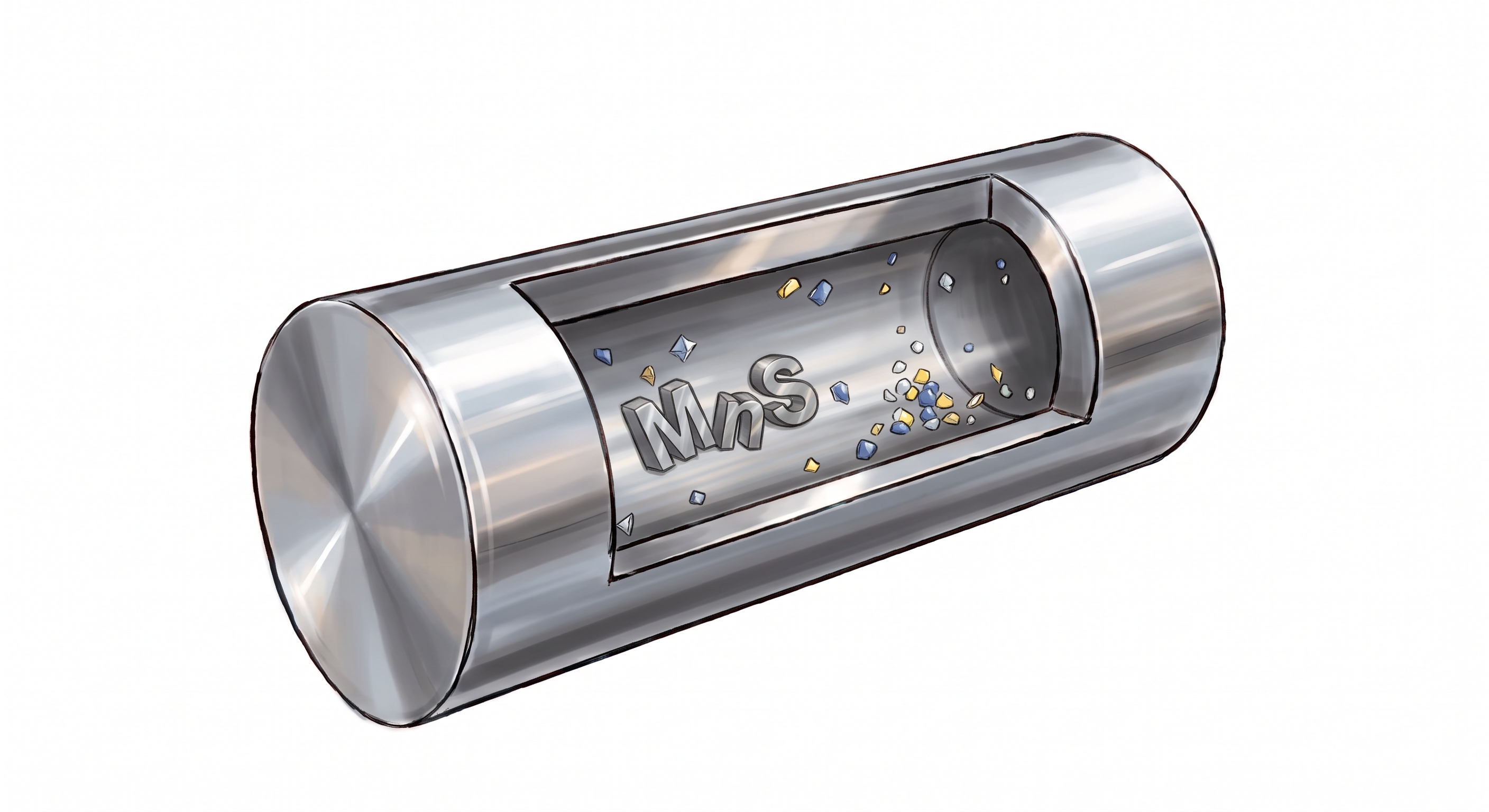
It is often thought that any non-metallic component hardens steel and complicates its machining, but here sulfur breaks the rules. When added to the alloy, it crystallizes forming small inclusions of manganese sulfide (MnS). Far from hardening it, this compound is considerably softer than the surrounding steel.

The result?
During machining, these sulfide points concentrate stress and cause the material to fail sooner. Instead of forming long, continuous chips, the material continuously breaks into small, easily evacuated fragments.
Solid lubrication against wear
Here is the interesting part regarding friction and wear. Beyond facilitating chip breaking, MnS forms a thin transfer film in the cutting area.
In the machining of stainless steels, it is very common to suffer from the dreaded built-up edge (BUE), a serious issue where the workpiece material welds to the tool, ruining the surface finish. The film generated by the manganese sulfide stabilizes the cut, acts as a thermal shield, and specifically prevents the material from adhering destructively to the cutting edges.
This protective effect is so efficient that it can increase machining performance up to fivefold in grades such as AISI 303 and AISI 416 a true lifesaver for the demanding ISO M category, known for its low machinability.
The counterpart: Impact on Corrosion
Optimizing one property almost always affects another. Although sulfur dramatically extends tool life, this microstructural modification reduces the steel's corrosion resistance, particularly against chlorides.
At a chemical level, sulfide precipitates are susceptible to anodic dissolution, which disrupts the passive layer protecting the stainless steel. Because of this, for marine environments or high chemical exposure, specific alloys exist that are designed to balance good machinability without compromising corrosion resistance.