Stainless steel does not expand or contract at the same rate depending on the family to which it belongs
Download PdfWhen a metal part is heated, its atoms absorb thermal energy, vibrate with greater amplitude, and require more space between one another: the material expands. Upon cooling, the vibrations decrease and the part contracts. The physical quantity that measures this behavior is the coefficient of linear thermal expansion (α). In practical terms, the coefficient indicates how many millimeters a metallic element expands per meter of length for each degree Celsius (°C) increase in temperature.
What does having a high coefficient of thermal expansion mean?
In practical terms, the coefficient indicates how many millimeters a metallic element expands per meter of length for each degree Celsius (°C) increase in temperature.
- A high coefficient means that the material exhibits high dimensional thermal sensitivity; it will elongate noticeably more for the same temperature change.
- A low coefficient means that the component offers greater dimensional stability, minimally altering its dimensions in response to temperature variations.
The metallurgical key: how atoms are arranged internally
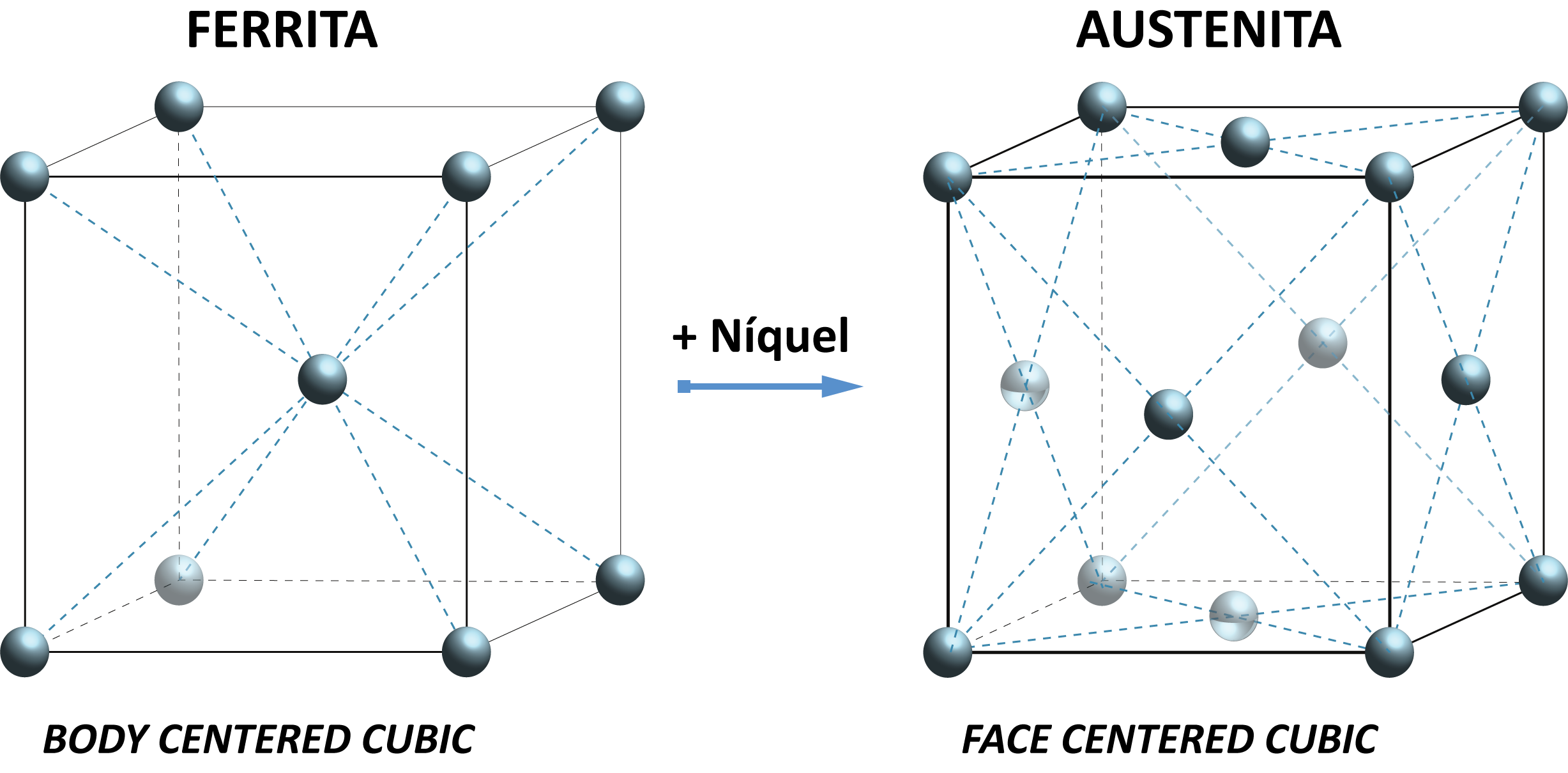
The difference in behavior among families lies in the geometry of their internal structure; the way their atoms are packed determines how much space they require when heated.
- Austenitic Family (e.g., AISI 304, AISI 316):
- The structure: organized in a face-centered cubic lattice (FCC structure). In this arrangement, atoms are in very direct contact with each other, like densely packed billiard balls.
- How it behaves: upon heating, any slight vibration immediately pushes neighboring atoms outward in a chain reaction. Lacking a rigid anchor point at the center, the structure yields and opens up easily.
- The outcome: it is the family that elongates the most with heat. Although grades such as 304 or 316 offer excellent resistance up to 870 °C without degrading, their high thermal expansion requires the inclusion of expansion joints in long piping or vessels to prevent expansion from rupturing joints.
- Ferritic Family (e.g., AISI 430, AISI 441):
- The structure: possesses a body-centered cubic lattice (BCC), where corner atoms are arranged around a single atom located at the core of the cube.
- How it behaves: that central atom acts as an anchor that "corsets" the entire assembly. Internal forces pull inward and firmly hold neighboring atoms, dampening the amplitude of their thermal oscillations. Even when the metal absorbs heat, the structure remains rigid and does not yield easily outward.
- The outcome: it offers high dimensional stability and expands nearly 40% less than an austenitic grade at the same temperature, minimizing the risk of deformation.
- Duplex Family (austenitic-ferritic):
- The structure: combines both geometries in a mixed microstructure (approximately 50% austenitic lattice and 50% ferritic lattice).
- The outcome: achieves intermediate behavior, balancing the thermal resistance of one phase with the lower thermal expansion of the other.
How does this influence the selection of stainless steel?
- Minimizing thermal fatigue: in components subjected to rapid, repetitive heating and cooling cycles (exhaust manifolds, mufflers, industrial burners, or heat exchangers), continuous volumetric change generates internal mechanical stresses. Ferritic steels, expanding significantly less, minimize these stresses and prevent permanent deformation or microcracking in the passive layer.
- Mechanical assemblies via shrink fitting (thermal fitting): the high coefficient of austenitic steels is a strategic workshop advantage. When heating an austenitic steel ring or gear, its inner diameter increases substantially, allowing it to fit easily onto a shaft; upon cooling, it recovers its original dimension, achieving a firm, uniform interference fit.
- Long-run installations: in high-temperature fluid piping or cylindrical tanks, anticipating whether the selected alloy is ferritic, duplex, or austenitic dictates the design of expansion bellows, loops, and lyres (flexible sections or bends designed specifically to absorb such elongation) and prevents thrust or overloading on connecting flanges (the bolted joints between pipes)
In the world of stainless steel, there are no inherently superior or inferior families; technical excellence consists in selecting the alloy whose thermal response adapts with millimeter precision to actual operating conditions.